Strategy Battles Real-Time War Updates | Unfiltered Conflict Coverage
Iran’s military apparatus, led by the Islamic Revolutionary Guard Corps (IRGC), remains under heavy pressure amid ongoing US and Israeli strikes. Despite significant losses in infrastructure and leadership, Iran continues limited ballistic missile and drone operations.
Iran’s Military Command Structure
The IRGC serves as the backbone of Iran’s defense and offensive strategy. It oversees:
- Ballistic missile and drone programs (IRGC Aerospace Force)
- Naval operations in the Persian Gulf (IRGC Navy)
- Proxy coordination across the region
- Internal security through the Basij militia
Ballistic Missile Forces – Current Assessment
Iran maintains one of the largest ballistic missile arsenals in the Middle East, but repeated strikes have caused major degradation.
- Approximately two-thirds of known missile production facilities and launch infrastructure have been damaged or destroyed.
- Around 330 out of 470 missile launchers are estimated to be inoperable.
- Iran has shifted to smaller, sporadic salvos to conserve remaining assets and reduce detection risk.
- Key targeted sites include Parchin, Imam Ali base in Khorramabad, facilities near Tehran, Isfahan, and Semnan.
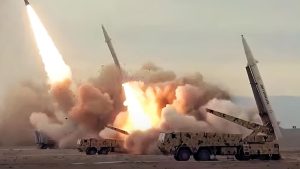
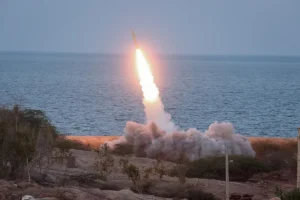
IRGC ballistic missile launches during exercises and operations.
Recent Leadership and Infrastructure Losses
- IRGC Navy Commander Rear Admiral Alireza Tangsiri and senior intelligence officers were killed in strikes on Bandar Abbas.
- Multiple waves of airstrikes hit missile production sites, underground storage, and air defense systems.
- Over 92% of Iran’s larger naval vessels have reportedly been destroyed or heavily damaged.

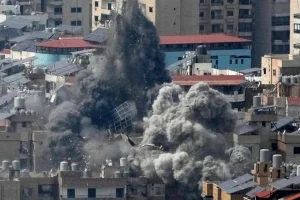
Smoke rises from damaged sites following reported strikes on Iranian military targets.
Naval and Asymmetric Capabilities
The IRGC Navy relies heavily on swarms of fast-attack boats armed with anti-ship missiles. These are designed for asymmetric warfare in the Strait of Hormuz.
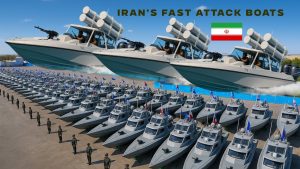
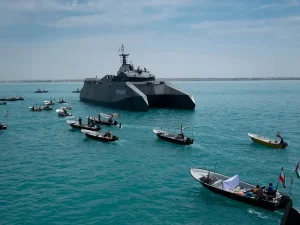
Iranian IRGC fast-attack boats and naval assets in the Persian Gulf.
Strategic Outlook
Iran continues to demand major concessions in any potential negotiations, including no further strikes, financial compensation, recognition of control over the Strait of Hormuz, and no limits on its missile program.
While Iran’s ability to conduct large-scale barrages has been reduced, its remaining forces still pose a threat through sporadic missile and drone attacks, supported by regional proxies.
This report is for news and analysis purposes only.
Copyright © 2026 Strategy Battles. All rights reserved.